

InvaPics
... an open, curated global database of photographs and short videos documenting the visible impacts of non-native species. It transforms scattered visual evidence into an accessible resource for research, education, communication and management.
Consortium
Phillip J. Haubrock, Neil Abreo, Paride Balzani, Teun Everts, Stelios Katsanevakis, Antonín Kouba, Irmak Kurtul, Lucian Pârvulescu, Jan Pergl, Conrad James Pratt, Ronaldo Sousa, Ismael Soto, Jingrui Sun and Ali Serhan Tarkan
(new members are welcome)
The importance of imagery
Visual evidence plays a fundamental role in how complex issues are understood, communicated and acted upon. Photographs and videos can make processes otherwise buried in data, statistics or technical descriptions immediately tangible. This is particularly important for environmental change, where consequences can remain abstract or difficult to appreciate. In invasion science, visual records can directly reveal impacts such as habitat transformation, native species displacement, predation or monoculture formation to researchers, policymakers, stakeholders, students and the wider public. A single clear visual record can often communicate an impact more effectively than pages of explanation or numerical scores alone. High-quality impact imagery is therefore not merely illustrative; it is a practical tool that shapes understanding, prioritisation and support for management actions.

The Problem

Despite a growing number of databases and citizen-science platforms dedicated to invasive species, much of the available information remains hidden in databases, spreadsheets, and technical reports. Meanwhile, available photographs and videos typically document the presence of non-native species rather than the ecological or socio-economic impacts they cause, and visual media retrieved through search engines or AI often lack verified identification, impact context, and essential metadata. As a result, researchers, managers and educators often lack readily accessible visual evidence of impacts when communicating risks, teaching, or supporting formal assessments such as EICAT. This absence of curated impact imagery also means that we have little easily accessible evidence, lack systematic knowledge of which types of impacts, taxa, and ecosystems are visually well-represented, and which non-native species and impacts remain largely invisible. The lack of an open, quality-controlled collection focused specifically on visible invasion impacts therefore limits both practical applications and our understanding of visual, perceptual and documentation biases in invasion science.
A global database as a solution

An open, curated global database of invasion-impact photographs and short videos would bring currently scattered visual evidence into a single, accessible resource. Visual records would be collected with standardised metadata, quality-controlled and openly licensed, allowing researchers, managers, educators and communicators to easily find and use evidence of impacts. Permanent archiving would ensure long-term accessibility and citability, while a user-friendly interface would make the collection easy to browse, search and filter. InvaPics would therefore transform dispersed visual evidence into a structured and reusable resource for invasion science, communication and management.
Key benefits of the database
-
Provides freely usable, visual evidence for outreach, teaching and stakeholder engagement
-
Supports formal impact assessments (e.g. EICAT) with visual evidence
-
Enables systematic analysis of invasion-impact visual evidence
-
Creates a citable, permanently archived open resource (Zenodo DOI)
-
Offers potential training data for AI-based detection and classification tools
-
Reduces duplication of effort by centralising visual records currently scattered across archives
-
Strengthens risk communication by making abstract impacts tangible
-
Can be expanded over time and potentially linked to existing platforms (Bugwood, iNaturalist, etc.)
The Potential
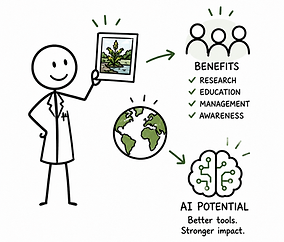
Beyond providing access to impact imagery, a global collection could become a research resource in its own right. Its growing coverage would reveal which taxa, regions, habitats and types of impacts are well documented and which remain largely invisible, enabling systematic analyses of geographic, taxonomic and visibility biases and helping prioritise future recording efforts. The visual records could support impact assessments, teaching, outreach, stakeholder engagement and management decisions, while providing evidence for funding and risk communication. An expert-curated, openly licensed dataset could also provide valuable training and validation material for AI systems, moving beyond species recognition towards detecting visual signatures of ecological impacts such as habitat alteration, vegetation damage or monoculture formation, but also economic and socio-cultural impacts. As the collection grows, it could support new research questions, technologies and applications that extend well beyond its original purpose.

Want to contribute?

Chances are, valuable evidence of invasion impacts is already sitting on phones, cameras and hard drives around the world. We want to tap into this largely unused resource by bringing photographs and short videos from scientists, practitioners, naturalists and anyone observing invasive species into one open collection.
We are looking for photographs and short videos that clearly show an impact of a non-native species—for example predation, damage to native species, displacement, dense invasive stands, or habitat modification. Each submission should include basic information:
1) What species?
2) Where was the photography/video taken?
3) What impact is shown?
etc.
Recognition of contributors: Accepted submissions will be credited to the photographer by name in the database and on the project website (with an optional link to a personal or institutional page). Major contributors will be specifically acknowledged, and all accepted material will be cited in the resulting data paper. We will also keep contributors informed about how the collection is used.
Submit your photograph/video:
GitHub submission: Coming soon!
Copyright
Please only submit photographs or videos that you took yourself or for which you hold the copyright (or have written permission from the copyright holder). Images found online, copied from publications, or taken by someone else without their consent cannot be accepted. By submitting, you confirm that you can license the material under the open licence selected on the form (preferably CC BY 4.0 or CC0).
Easy submission guide:

